
Understanding why an 11kW EV charger may show 3.7kW, 7.4kW, or another lower charging rate—and what to check before blaming the charger.
You plug in your EV expecting 11kW, but the display shows only 3.7kW or 7.4kW. Does that mean your 11kW charger is faulty? Usually, no.
Actual AC charging power depends on the vehicle, electrical supply, number of phases, selected current, EV settings, and charging conditions. Before replacing the charger, identify which part of the charging chain is limiting power.
Quick Answer
11kW is the maximum capability of a compatible charging setup, not a guaranteed charging speed. Actual AC charging power is determined by the car, power supply, phases, current setting, and vehicle settings. If one part is limited, the charging rate can be lower.
Car + Power Supply + Phases + Current + Settings = Actual AC Charging Power
Does an 11kW Charger Always Charge at 11kW?
No. An 11kW EV charger can only provide its full rated output when the entire charging setup supports it.
That includes the EV’s onboard AC charger, a suitable three-phase supply, the required voltage and current, compatible cable and connector, vehicle settings, and the EVSE current setting.
11kW is a capability, not a guaranteed result.
Does Your EV Support 11kW AC Charging?
Before checking the charger, check the car.
During AC charging, the vehicle’s onboard charger converts AC power into DC power for the battery. That onboard charger has its own maximum AC charging rate.
If your EV accepts a maximum of 7.4kW AC, connecting it to an 11kW EVSE will not make it charge at 11kW. The vehicle becomes the limiting factor.
Check the manufacturer’s maximum AC charging specification rather than its DC fast-charging figure.
Do You Have Three-Phase Power?
Three-phase availability is one of the most common reasons an 11kW charger does not reach 11kW.
| Electrical Setup | Approx. Charging Power |
|---|---|
| 400V + Three Phase + 16A | Up to 11kW |
| 230V + Single Phase + 16A | Approx. 3.7kW |
This is why an 11kW-capable charger can still show around 3.7kW. The EVSE may support 11kW, but a single-phase supply cannot provide the full three-phase configuration.
No three-phase supply = no full 11kW three-phase charging.
The vehicle and EVSE must also support the setup. If you are unsure about the supply, ask a qualified electrician.
Why Am I Only Getting 3.7kW or 7.4kW?
Around 3.7kW is commonly associated with 230V single-phase charging at 16A. Around 7.4kW may appear with certain higher-current single-phase setups or when the vehicle limits AC charging.
Ask which part of the charging setup is limiting the power—not simply why the charger is not reaching 11kW.
Does the Current Setting Affect Charging Speed?
Yes. Lower current means lower available charging power.
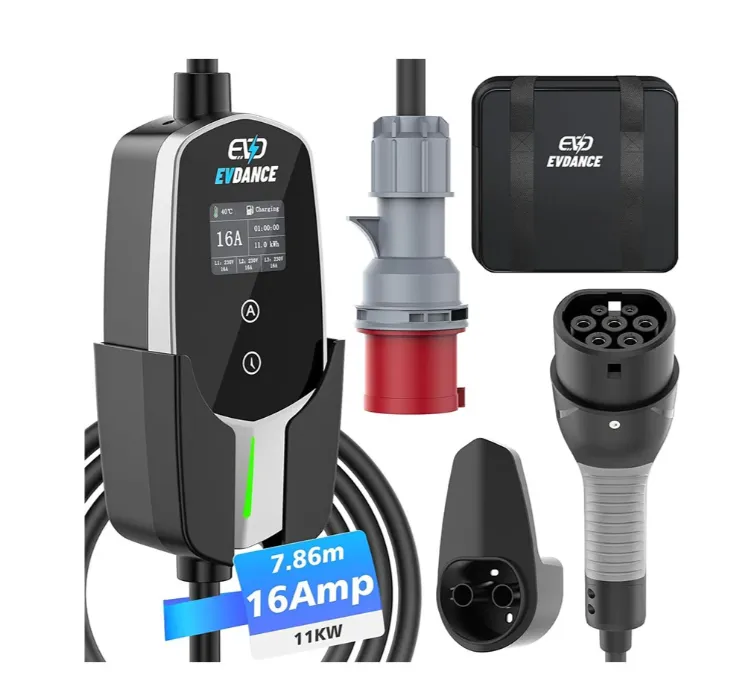
The EVDANCE 11kW CEE Mobile Wallbox with APP supports adjustable current settings of 6A, 8A, 10A, 12A, and 16A. If it is set to 8A or 10A, it should not be expected to provide the same power as at 16A.
Adjustable current is useful because charging conditions vary, but the selected current must always be appropriate for the socket, wiring, circuit protection, EVSE, and vehicle.
Can the Electrical Supply Limit an 11kW Charger?
Absolutely.
An 11kW charger cannot create 11kW from an electrical supply that cannot provide it.
A compatible EVDANCE 11kW setup uses 400V three-phase power, a 16A CEE connection, and a Type 2 vehicle connector. If the property provides only single-phase power or another electrical limitation exists, actual charging power will be lower.
How Can I Check My Actual Charging Power?
Real-time data can help identify what is happening during a charging session instead of guessing from the rated power.
Check Actual Current and Voltage
The EVDANCE 11kW mobile wallbox provides real-time charging information on its display, helping you see whether the session is operating at the expected current and voltage.
Monitor Charging Status
EVDANCE smart APP charging can help confirm whether the vehicle is actively charging, paused, stopped, or operating normally without standing beside the control box.
Review Charging Schedules
If charging does not start immediately, a scheduled or delayed charging setting may be responsible. APP monitoring can help you check whether the session follows the configured schedule.
Track Energy Use
Energy information shows how much power has been delivered during a session, helping distinguish a real problem from a charger operating within vehicle or supply limits.
Smart monitoring does not make an EV charge faster than its technical limits. It helps explain why a charging session is behaving the way it is.
When Does an 11kW Mobile Wallbox Make Sense?
An 11kW mobile wallbox makes sense when your EV supports three-phase AC charging and the location provides a compatible three-phase CEE supply.
Its portable design can be useful at home, in a garage, at a workplace, or between multiple charging locations. However, portable does not mean “charge anywhere.” Every location still needs a safe, compatible electrical connection.
Different drivers may need different configurations. A household outlet may call for a lower-power portable solution, a 230V CEE supply may suit a higher-power single-phase option, and a 400V three-phase CEE supply can support 11kW mobile charging. Drivers who want remote monitoring may prefer an APP-enabled model.
Before Blaming Your 11kW EV Charger, Check These 7 Things
✓ Does your EV support 11kW AC charging?
✓ Do you have three-phase power?
✓ Is the supply suitable for 400V / 16A charging?
✓ Is the EVSE current set below 16A?
✓ Does the vehicle have an AC charging limit enabled?
✓ Are there electrical or temperature-related restrictions?
✓ Are you comparing rated maximum power with actual charging power?
If your 11kW EV charger is not charging at 11kW, the EVSE may still be working correctly. The vehicle, phases, selected current, electrical supply, or settings may be the real limiting factor.
Explore EVDANCE Portable EV Chargers
Compare portable charging options designed for different European electrical setups, power levels, and charging requirements.
